This project began as my undergraduate Honors Thesis. Over the course of a semester, I gathered together many queer moments in ballet and synthesized them. By making my research available on this website, I hope that it can be expanded upon to reach other queer dancers and teachers who feel that they don’t fit within the cisheteronormative world of ballet. I began here: if I look back in history and find that there are roles for people like me, that women partnered women, that gender is not so central to deciding which steps I am allowed to do, perhaps I don’t have to do all the work of making spaces for LGBTQ+ people in ballet. I am asking “What if ballet was always queer? What if I don’t have to queer it at all, I just have to look with a closer eye?” By looking to the past, I hope we can build a vision of a world wherein ballet belongs to all of us.
Approaching Queer History
A key term in this work is cisheteronormativity: cisheteronormativity is defined by the social and structural elements under which identification and/or behavior as cisgender and heterosexual are privileged, idealized, and normalized. Cisheteronormativity often works to reinforce gender binaries, homophobia, transphobia, patriarchy, and sexism.
In this project queer history is not defined by an explicit intention for a work to be read as queer or by an explicit identification of any artist with LGBTQ+ identities. Instead, I will focus on moments in ballet history that do not conform to modern notions of cisheteronormativity.
This is for a number of reasons. First, queerness has been, to varying degrees, illegal and/or stigmatized throughout history. Because of this, it is often obscured, coded, and kept secret. Thus, to rely upon only specific intentions of open queerness would limit this research to a relatively short snippet of the past century or so. Second, queerness, at its core, is not easily defined, and its definition has shifted though time. As such, it is not reasonable to expect historical works or figures to use modern-day terms to describe their queerness.
About the Author
Oliver Vi Myers (he/they) began their dance training at the age of eight at Littleton Ballet Academy. In Fall of 2021, Oliver joined the Colorado State University Dance program. He has been selected to perform at least once each semester. Oliver’s Resonant Body solo and lecture demonstration was created as an Honors project for CSU Dance’s Repertory Engagement Course and was performed across Colorado, from Sterling to Gunnison and at TEDxCSU 2023. Their choreography, Body: to be seen and Look Like, has been selected for CSU’s mainstage concerts. Since December 2021, Oliver has served as a research assistant to Professor Madeline Harvey on the Movement Through Parenthood project. In winter of 2023-24, Oliver traveled to Ghana to study West African and afrobeats dance through community engagement and transnational solidarity with CSU’s Ethnic Studies and Women and Gender Studies departments.
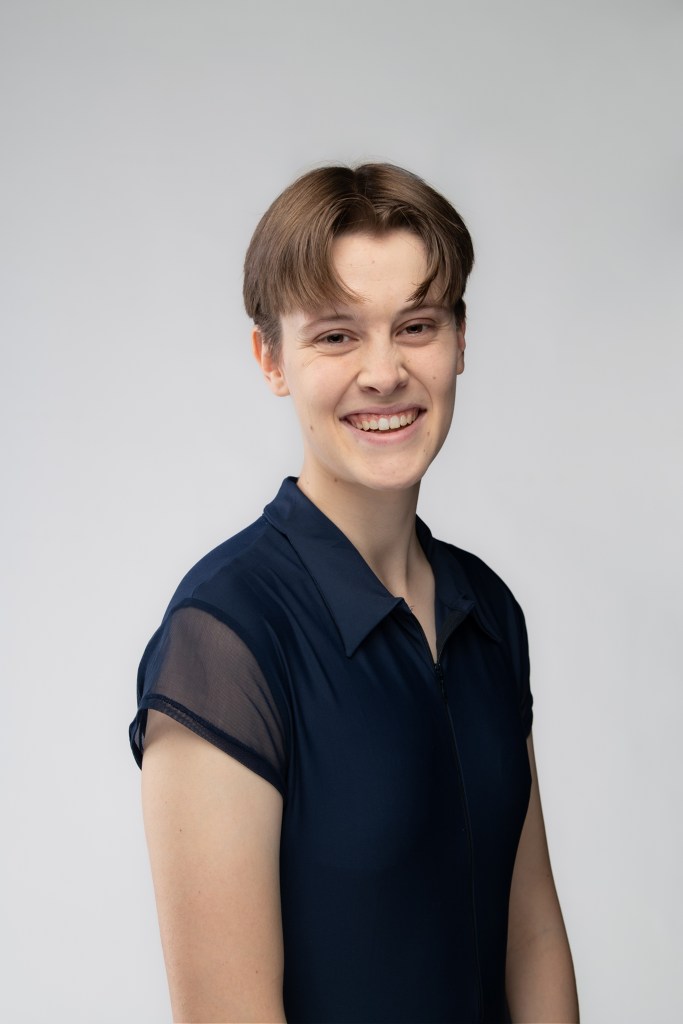
He has presented on teaching, choreography, and research at NDEO conferences in both 2023 and 2024. Outside of their academic work, Oliver loves backpacking, knitting, reading, and queer history. They have been skiing longer than they’ve been dancing and have skied at nearly every resort in Colorado. Oliver is also a member of the CSU Biology Teaching Collections Club and Knits of the Round Table, CSU’s campus knitting club. He is grateful to his friends, family, faculty, and mentors for their support of his ambitious academic and career pursuits. After completing their undergraduate degrees, Oliver plans to pursue professional concert dance and choreography before returning to graduate school to study conservation biology.
 Queer Ballet History